






Aftermarket activity

Industrialization of innovative projects

Back to the list

Accelerator pedal position sensor

The advent of the autonomous car has highlighted the fundamental importance of high-performance sensors. However, we have long been committed to providing our customers with effective – and reliable – sensors. So, whether you’re looking for sensors for the engine and transmission, or for comfort and safety – not forgetting emissions and e-mobility – take a look at our product ranges.

Back to the list
Accelerator
pedal position sensor

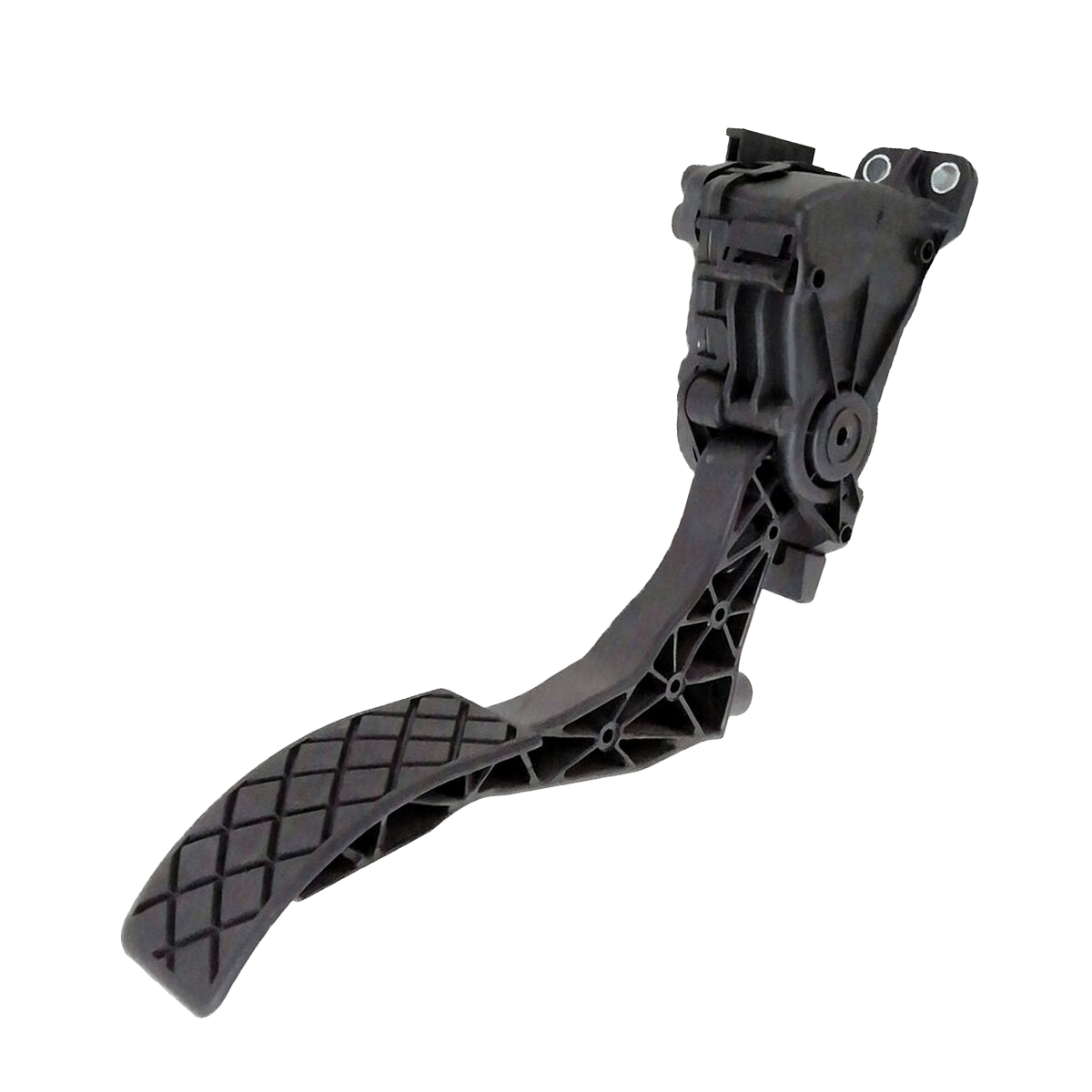
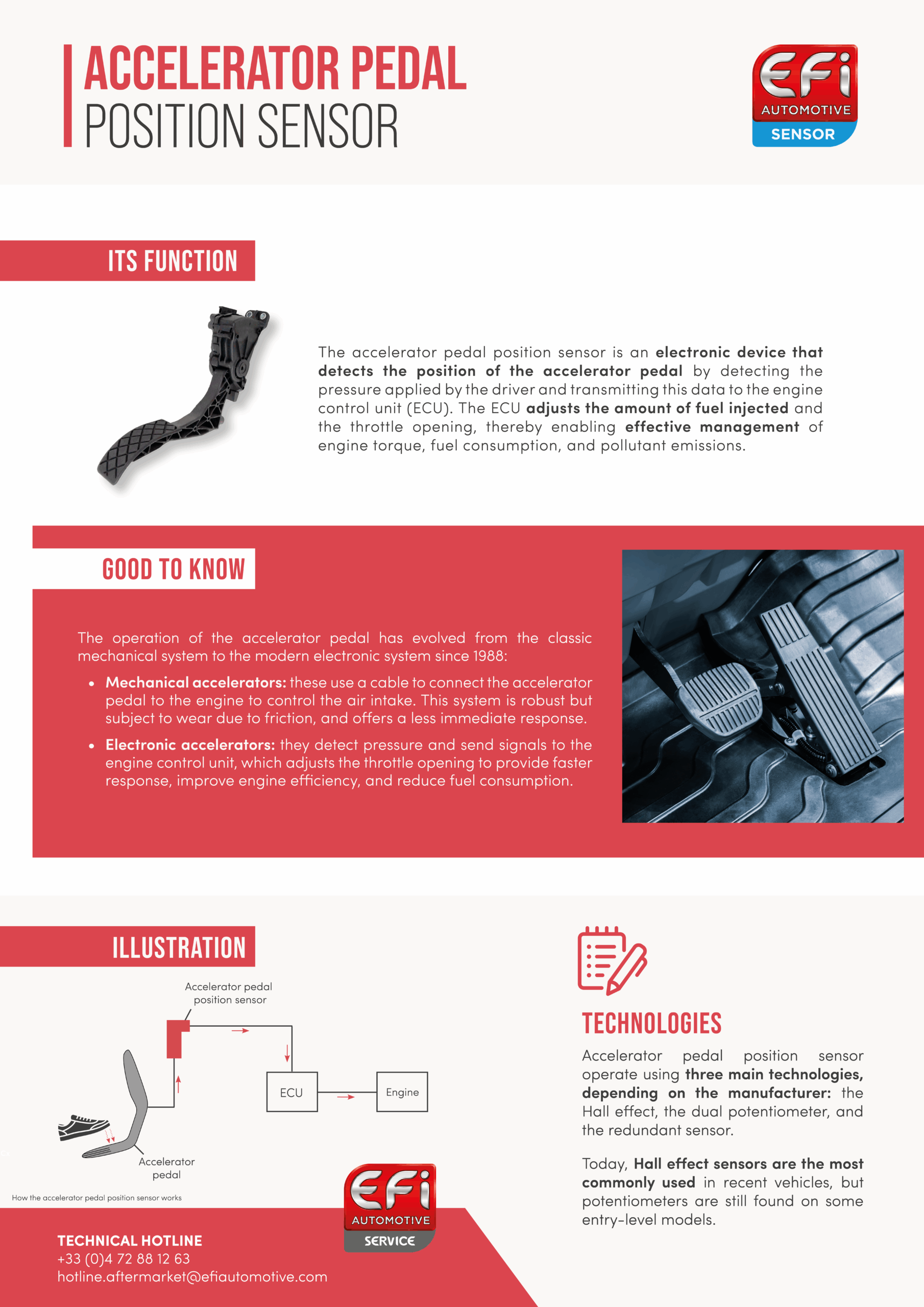
Also known as a ‘pedal position sensor’ or ‘pedal potentiometer’, this sensor measures the exact position of the accelerator pedal. It replaces the traditional mechanical cable and transmits electronic information directly to the engine control unit (ECU).

In practical terms, when the driver presses the pedal, the sensor converts the movement into a proportional electrical signal. This signal is then interpreted by the ECU, which determines the optimal accelerator opening or the amount of fuel to be injected into the engine, depending on the technology used. This real-time communication allows for precise control of engine torque, improves vehicle responsiveness and helps reduce fuel consumption and pollutant emissions.

The sensor’s main function is therefore to translate the driver’s intention into a reliable electronic command, ensuring: a rapid and proportional response from the engine to the requested acceleration, the possibility of activating safety or limitation modes (degraded mode) in the event of a fault, and a contribution to optimising fuel consumption and reducing pollutant emissions.

Technologies
Technical information
Frequently asked questions
Resources
Technologies

POTENTIOMETRIC TECHNOLOGY

Also known as a ‘pedal potentiometer’, this sensor uses a variable resistance principle to convert the mechanical position of the pedal into an electrical signal. The pedal shaft drives a slider that moves along a resistive track; the variation in resistance changes the sensor’s output voltage.

This voltage, which is proportional to the pedal travel, is transmitted to the engine control unit (ECU), which uses it to determine the torque requested by the driver. This simple and economical technology has long been the standard for electronic throttle systems.

However, the mechanical contact between the slider and the resistive track can eventually cause wear and electrical interference. For this reason, manufacturers are increasingly turning to contactless solutions, which offer better long-term reliability.

CONTACTLESS TECHNOLOGY

Modern pedal position sensors mainly use contactless technologies, such as the Hall effect or magnetoresistive sensors (AMR/GMR). A magnet is attached to the pedal shaft; the sensor measures the variation in the magnetic field according to the angle of rotation.

This approach eliminates mechanical friction and wear, ensuring a stable and accurate signal throughout the vehicle’s lifetime. The sensor transmits two redundant signals with different response curves, allowing the ECU to compare the values and detect any anomalies.

Thanks to this redundancy and compliance with functional safety requirements (ISO 26262), these sensors guarantee a high level of reliability and contribute to optimal engine torque control, improved responsiveness and reduced pollutant emissions.

Technical information

SYMPTOMS

The following symptoms are frequently associated with a faulty accelerator pedal position sensor:

  • Loss of power or vehicle in degraded mode;
  • Engine warning light or warning message on the dashboard;
  • Slow or irregular accelerator response;
  • Jerking or jerky operation during acceleration;
  • No response when pressing the pedal;
  • Unexpected variation in engine speed without pressing the pedal.


DIAGNOSIS PROCEDURE

It is important to visually inspect the accelerator pedal position sensor to determine whether it is faulty. It is therefore strongly recommended that you check the following:

  • The electrical connector (oxidation, bent pins, cut or damaged wire);
  • The sensor (no dirt or liquid);
  • The pedal (check for freedom of movement).

Using a multimeter, it is possible to check the supply voltage (usually 5V supplied by the ECU) and the ground (continuity and absence of parasitic resistance).

It is also recommended to measure the sensor output voltage (channel A and channel B) by gradually varying the pedal:

  • At rest: typical voltage between 0.3 and 0.8V.
  • At full stroke: typical voltage between 4.0 and 4.5V.

The variation must be linear and regular. Check the consistency of the two channels: they must evolve simultaneously but with different laws (functional safety).

If the above tests are inconclusive, the accelerator pedal position sensor in your vehicle needs to be replaced.

CAUSES OF FAILURE

An accelerator pedal position sensor may stop working due to:

  • Mechanical wear (damaged resistive track on potentiometric models);
  • Water ingress into the connector or sensor;
  • Extreme temperatures (expansion/contraction causing microcracks);
  • Electromagnetic interference (in rare cases, on poorly shielded magnetic sensors);
  • Electrical causes (loose connector, damaged wiring harness, poor ground connection).

INSTALLATION INSTRUCTIONS

To ensure quick and efficient installation, please refer to the following instructions:

  1. Remove any trims or protective covers around the pedal if necessary.
  2. Disconnect the sensor’s electrical connector.
  3. Unscrew the sensor’s fasteners (usually 2 or 3 screws).
  4. Carefully remove the sensor, taking care not to pull on the wires or the pedal.
  5. On the new sensor, apply the manufacturer’s recommended non-conductive lubricant to the axle.
  6. Position the sensor on the pedal and/or bracket.
  7. Secure the sensor with the screws and tighten to the torque recommended by the manufacturer.
  8. Reconnect the electrical connector, ensuring that it is properly engaged.
  9. Check that the pedal moves freely and smoothly, without any sticking or excessive play.

INSTALLATION TIPS

It is important to follow a number of guidelines when replacing it:

  • Clean the accelerator valve, as the new sensor alone will not compensate for a dirty throttle valve;
  • Replace the return springs or silent blocks if they are worn, as incorrect pedal movement can distort the sensor measurements;
  • After replacement, perform the pedal learning/calibration procedure if recommended by the manufacturer.

PREVENTIVE INFORMATION

The above items are provided for information purposes only. They do not replace the advice of a qualified technician or mechanic. We strongly recommend that you consult a professional if you are unsure of what to do. Otherwise, we cannot accept responsibility for any damage to your vehicle.

Frequently asked questions
What symptoms should I look out for?

When the accelerator pedal position sensor malfunctions, the signal transmitted to the engine control unit may be erratic or absent, causing noticeable malfunctions while driving. The vehicle may exhibit slow or irregular throttle response, with jerks during acceleration, loss of power, or activation of a degraded mode that limits engine speed to ensure safety. The engine warning light may also come on, accompanied by warning messages on the dashboard, and the engine speed may vary unexpectedly or even remain at idle despite pressing the pedal. These anomalies reflect poor transmission of the driver’s intention to the ECU and require prompt verification in order to maintain responsiveness, safety and driving comfort.
How to identify the fault?

Firstly, we strongly recommend that you visually inspect the accelerator pedal position sensor, i.e. its connector (for oxidation, bent pins, cut or damaged wires), the sensor itself (for dirt or liquid) and the pedal (to check that it moves freely).

Next, you can test that your sensor is working properly by checking its supply voltage (usually 5V supplied by the ECU) and ground (continuity and absence of parasitic resistance).

You can also measure the sensor’s output voltage (channel A and channel B) by gradually varying the pedal:

  • At rest: typical voltage between 0.3 and 0.8V.
  • At full stroke: typical voltage between 4.0 and 4.5V.

The variation must be linear and regular. Check the consistency of the two channels: they must change simultaneously but with different laws (functional safety).

If the above tests are inconclusive, then it would appear that you will need to replace your vehicle’s accelerator pedal position sensor.

Why does my throttle pedal position sensor need replacing?

Aaccelerator pedal position sensor can become defective for several reasons related to its mechanical or electronic operation or its environment. Natural wear and tear on the sensor, particularly on potentiometer models, can cause unstable or erratic signals. Electrical problems such as an oxidised connector, damaged wire or missing power supply can also prevent information from being transmitted correctly to the ECU. In addition, external influences such as humidity, dust, liquid splashes, extreme temperatures or excessive vibrations can damage the sensor or disrupt its operation. Finally, a fault in the ECU or carelessness when working on the wiring harness or pedal can cause inconsistencies in the signal. These causes, whether mechanical, electrical or environmental, compromise the accuracy of engine control and require careful checking to ensure the safety and reliability of the vehicle.

What are the installation instructions?

We recommend the following steps to replace your accelerator pedal position sensor as efficiently as possible and to limit possible mistakes.

  1. Remove any trims or protective covers around the pedal if necessary.
  2. Disconnect the sensor’s electrical connector.
  3. Unscrew the sensor’s fasteners (usually 2 or 3 screws).
  4. Carefully remove the sensor, taking care not to pull on the wires or the pedal.
  5. On the new sensor, apply the manufacturer’s recommended non-conductive lubricant to the axle.
  6. Position the sensor on the pedal and/or bracket.
  7. Secure the sensor with the screws and tighten to the torque recommended by the manufacturer.
  8. Reconnect the electrical connector, ensuring that it is properly engaged.
  9. Check that the pedal moves freely and smoothly, without any sticking or excessive play.
What tips should I use to extend the life of my throttle pedal position sensor?

In order to extend the life of your sensor, we strongly recommend that you follow these installation recommendations:

  • Clean the throttle valve, as the new sensor alone will not compensate for a dirty throttle valve.
  • Replace the return springs or silent blocks if they are worn, as incorrect pedal movement can distort the sensor measurements.
  • After replacement, perform the pedal learning/calibration procedure if recommended by the manufacturer.
Resources
You can download the best-sellers associated with this product family below.
Summary sheet
Find out more about throttle pedal position sensors.
Download
Best-sellers
Find out more about our top 8 sellers for the European market.
Download